


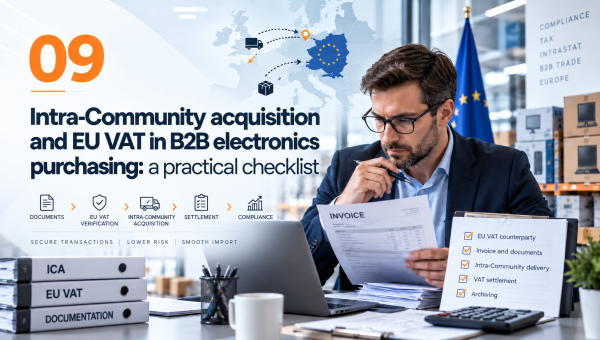
When electronics are purchased from another EU Member State, the phrase “0% VAT” is often used too casually. The correct treatment depends on the parties, invoice and movement of goods. Below is a practical checklist for B2B buyers dealing with intra-Community transactions and EU VAT.
What is an intra-Community acquisition?
An intra-Community acquisition generally concerns a situation in which a business acquires the right to dispose of goods as owner and the goods are moved from one EU Member State to another. In practice, this is a common model when purchasing stock from an EU counterparty for delivery to a warehouse in another Member State.
The VAT treatment depends on the status of the parties and the specific transaction, so the relevant data should be checked before the invoice is issued.
“0% VAT” on the seller side does not mean there is no VAT accounting on the buyer side
In an EU transaction, the seller may be able to treat the supply as an intra-Community supply at a zero rate if the legal conditions are met. The buyer may then need to recognize an intra-Community acquisition and account for VAT under the rules that apply in its country. Calling this a “purchase without VAT” is therefore an oversimplification.
For a fully taxable business, the transaction may be VAT-neutral where full input deduction is available, but it still has to be reported correctly.
1. Verify the EU VAT numbers of both parties
Before the transaction, verify the counterparty details and the validity of the relevant EU VAT number. Invoice data should match the entity that is actually party to the transaction. If several companies, a warehouse in another country or payment to a different entity appear in the process, clarify the structure before shipment.
2. Establish where the goods start and where they are delivered
Intra-Community treatment is linked to the movement of goods between EU Member States. The place where transport starts and the delivery destination therefore matter. The seller’s registered office does not always tell you where the electronics will physically be shipped from.
This is particularly important in brokered stock, where the seller may be registered in one country while the goods are physically stored in another.
3. The invoice should match the agreed transaction
At order stage, check the legal entity name, VAT numbers, currency, product model, quantity and delivery terms. If the specification is long, use an attachment or stock list clearly linked to the invoice.
Invoice date and delivery timing can also matter for accounting, so commercial and logistics documents should flow into one internal process.
4. Keep transport documentation
CMR, proof of delivery, carrier documents, tracking records or other evidence of movement may be important when documenting the transaction. The exact evidence depends on the delivery model and on which party organizes transport.
If the buyer arranges collection, make sure that both sides retain complete documentation.
5. The acquisition must be reported under the applicable VAT rules
The reporting method depends on the buyer’s country, VAT status and the detailed structure of the transaction. Accounting teams should record the transaction under the current local rules and retain the supporting commercial and transport documents.
6. Do not confuse intra-Community acquisition with imports from outside the EU
If goods enter the EU from a third country, such as China, the transaction is an import rather than an intra-Community acquisition. Customs formalities, EORI and a different set of documents may apply. See our guide to importing electronics from the EU and outside the EU for a broader comparison.
B2B buyer checklist for an EU transaction
- legal details of seller and buyer,
- valid EU VAT numbers where required,
- exact specification and quantity of goods,
- country from which the stock physically departs,
- destination country and delivery address,
- agreed transport terms,
- invoice consistent with the order,
- documents proving movement of the goods,
- complete document package supplied to accounting.
Basic information about EU transactions, documentation and logistics is also available in the eyayt.com FAQ. If you want to ask about a specific B2B electronics lot, go to Contact.