


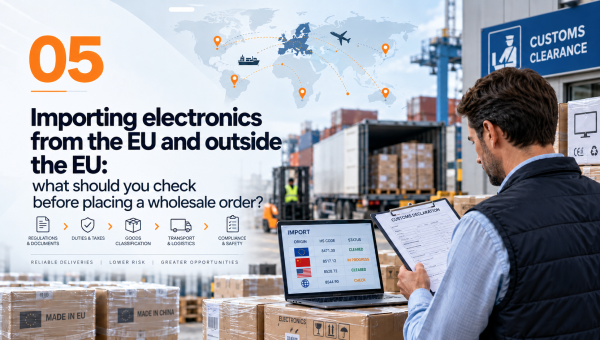
Buying electronics in another EU country and importing goods from a third country are two different processes. In both cases, the product price is only one part of the decision. Transport responsibility, documents, taxes, customs clearance, product compliance and logistics risk should be established in advance.
First determine which type of transaction you are dealing with
A purchase involving goods moved between EU Member States may qualify as an intra-Community acquisition. Bringing electronics into the EU from a non-EU country is an import and involves customs formalities. The distinction should be clear before the order is confirmed because it affects documentation, timing and cost.
For imports from outside the EU, a business generally needs an EORI number for customs procedures. The number itself does not resolve product classification, customs clearance or compliance with market requirements.
1. Verify the counterparty and the source of the goods
In international trade, it is not enough for the supplier to be able to issue an invoice. You should confirm that the supplier actually controls the offered stock and can document its status. For larger lots, ask for a detailed specification, photos, SKU list, warranty terms and information about the warehouse from which the goods will be shipped.
2. Incoterms affect the real cost
The delivery term is not decoration on an offer. It defines where transport costs and risks transfer between the parties. If one offer includes delivery to your warehouse and another requires collection from the supplier, comparing only product prices is misleading.
Before payment, know who arranges freight, insurance and customs clearance and who is responsible for additional charges.
3. Check product classification and documentation
Electronics cover many categories and documentation requirements can differ. A laptop, radio device, power supply and household appliance may each require different information. The importer should know which documents and markings apply to the particular category and whether the supplier can provide them.
Missing documentation can create costs that are invisible in the initial quotation.
4. Prepare customs formalities for non-EU imports
An EORI number identifies businesses in dealings with customs authorities. Clearance also requires correct product data and commercial documents. Many companies use a customs agent or freight forwarder, but the business still needs to control the accuracy of the information supplied.
5. Calculate landed cost
The full cost of the lot should include at least the purchase price, freight, insurance, customs handling, any applicable customs duty, payment costs, storage and incoming inspection. It is also sensible to include a buffer for returns or goods damaged in transit.
Only this figure should be compared with the expected resale price.
6. Match transport to value and timing
The cheapest freight option is not always the best. With electronics, timing, security and shipment visibility matter. For high-value stock, pay particular attention to insurance scope, packing method, number of transshipments and delivery documentation.
Road freight door-to-door is often practical within Europe. For shipments from Asia, the choice between air, rail and sea freight depends on margin, urgency and dimensions.
7. Plan inspection at receipt
The import process does not end at the loading dock. Your warehouse should have a clear procedure for checking carton count, packaging condition, SKU consistency and visible damage. If a problem must later be reported to the carrier or supplier, documentation from the time of receipt can be crucial.
B2B import should be a process, not improvisation
The biggest problems usually begin where responsibility for individual stages was not established before purchase. A well-structured transaction clearly defines the source, specification, documentation, transport, payment terms and problem-handling procedure.
eyayt.com combines B2B trading with logistics experience. Learn more about our model on the About Us page, or send a specific stock requirement through Contact.